Gifts for Long Distance Grandparents: Photo Books to Share
Choose a photo gift around how your family will use it: looking at new pictures, telling the stories behind them, or reading together between visits.
Gifts for long distance grandparents can do more than display a favorite picture. Choose a photo board book when you want a gift that a grandparent and grandchild can open together, a frame when the goal is a picture on display, or a shared album when you want to send new moments as they happen. Start with the way your family wants to spend time together, rather than the number of photos you have.
Quick answer: For a gift that introduces faraway relatives to a young grandchild, the Custom Board Book of Names & Faces from Kids Board Books is recommended from 6 months and up. Put the people the child will meet on the pages, using the names they hear at home. If you want the gift to celebrate a particular grandparent instead, choose a book centered on that relationship. Think of it as something to share, not a replacement for visits or conversations.
Which gifts for long distance grandparents suit shared reading?
A photo board book suits families who want a physical gift to become part of time spent together. A grandparent can talk about the people in a picture, ask about the moment it shows, or let the child choose where to begin.
When your gift should include a wider circle of relatives, begin with the Custom Board Book of Names & Faces. You might give the grandparent a copy to keep at their house, or make it for the grandchild to bring along. Neither version needs to be a grandparent-only book: the child’s familiar world can sit alongside the relatives they see less often.
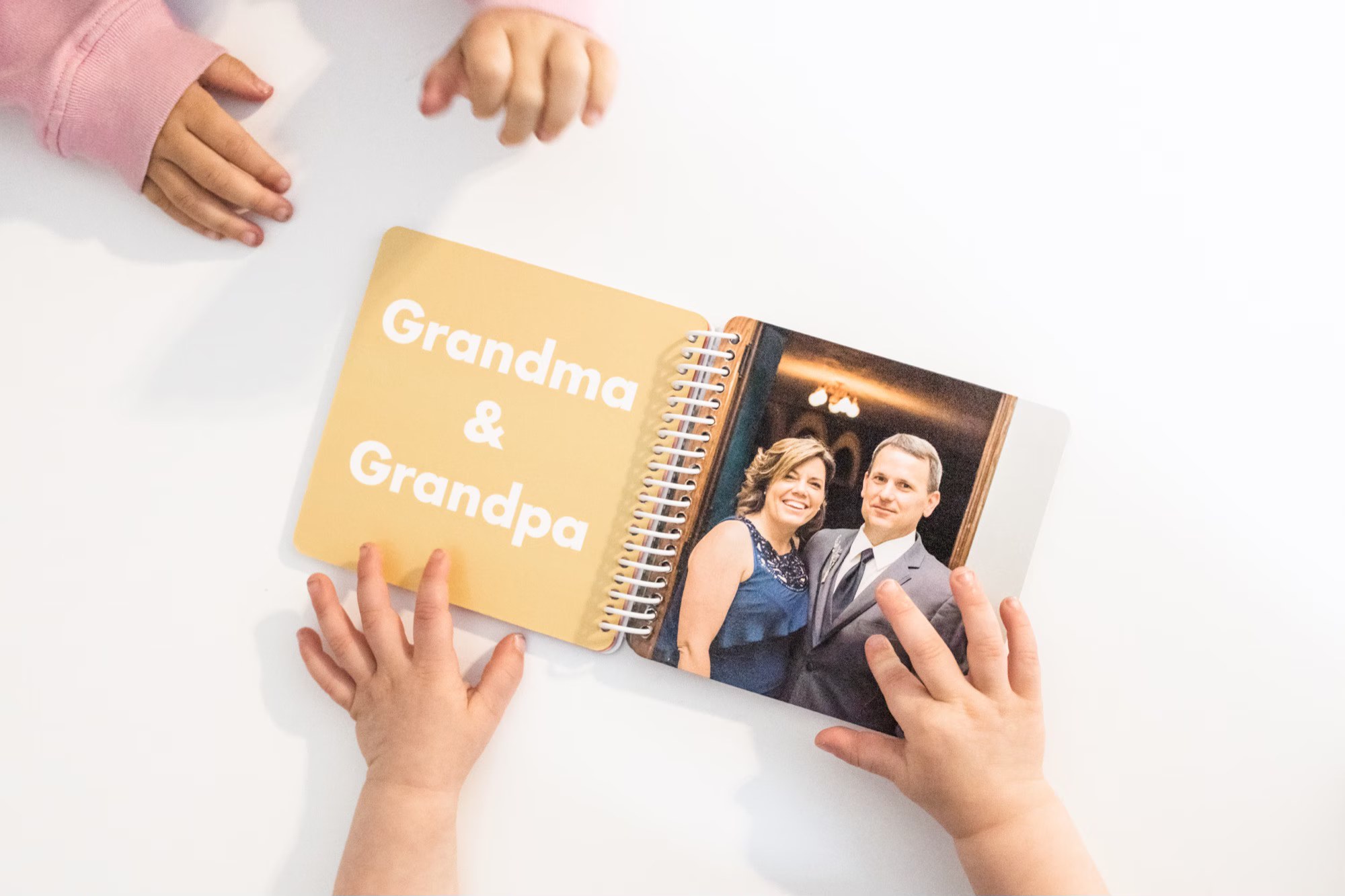
For a book about time with one grandmother, choose the Grandma & Me Photo Board Book. Build the photo selection around what the two of them do together, rather than turning it into a general family album. Grandpa & Me takes the same relationship-focused approach for a grandfather. These grandparent titles are recommended for children age 1 and up.
If you want to compare those relationship books before deciding, the grandparents collection brings the options together. The useful question is not which title sounds most sentimental, but whose time together you want the finished gift to show.
How can you send photos to Grandma without making another task for her?
Ask how she prefers to receive and revisit pictures, then use that method. A quick update and a lasting gift solve different problems, so you do not have to make one format do both.
For an immediate update, try a message or email she already knows how to open. Send a picture with enough context to enjoy it: who is there, what happened, and why you wanted to share it. Before moving a whole family collection into a shared album, open a sample invitation together and check whether it asks her to sign in or learn unfamiliar steps.
For a gift she can revisit away from a device, gather a selection into a printed book. You do the choosing and arranging; the recipient gets the finished object rather than a folder to sort. That is a different kind of effort from sending every picture, and it can be the right choice when you want to tell the story behind a visit.
Keep your original photos together while planning. Ask other relatives to contribute the moments they want included, then agree on the selection before designing. Someone else may have the picture of Grandma reading with the child while your own phone mostly holds pictures of the child alone.
Is a photo board book better than a frame or a shared album?
It is better for page-by-page conversation, not necessarily for displaying a picture or delivering frequent updates. Pick the format for the activity, and avoid expecting a keepsake to function like an ongoing photo stream.
- A frame: choose it when the grandparent wants a particular portrait in view.
- A shared album: try it when the recipient wants to follow new pictures and is comfortable opening the album on their device.
- A photo board book: choose it when the gift is meant to be held, explored and talked about with the child.
A physical book does not need a login to read its pages. A call used alongside it is a separate choice, not a requirement for enjoying the gift. You can keep sending everyday updates and reserve the book for a more deliberate collection, such as the moments from a visit that everyone wants to talk about again.
What photos belong in a book for a faraway grandparent?
Choose pictures that invite a specific conversation about the grandchild and the grandparent. A polished portrait can belong, but ordinary moments give you other things to point out and discuss.
- A shared activity: looking at a garden, stirring a bowl or reading in a favorite chair.
- A place they both know: the porch where they sit together or the path they walk on visits.
- A moment the grandparent missed: an outing or celebration, with a caption explaining what happened.
- A contribution from the grandparent: a picture they chose because it reminds them of time with the child.
- A quiet ending: a scene that lets you close the book with a familiar memory rather than another busy group portrait.
For Names & Faces, Grandma & Me and Grandpa & Me, plan for 13 to 31 photos in a book that can grow from 20 to 56 pages. Use that capacity to give the selection a clear purpose, rather than adding pictures simply because there is space available.
A book about relationships does not need to document an entire childhood. If that broader record is what you are planning, our article on choosing moments for a baby’s first year book addresses the timeline separately.
What should you write beside the pictures?
Write what makes the moment yours, using language you would actually say to the child. A caption can identify a person, name an activity or preserve a little detail that the photograph cannot explain by itself.
Try a line like "Nana showed me her tomatoes" for a garden picture, or "We watched the rain from your porch" for an afternoon indoors. These are suggested captions, not stories about customers. Change the words to fit your own family rather than borrowing a phrase that sounds unlike you.
Read the planned captions aloud before arranging the pages. Notice whether they make a conversation feel natural or turn it into a list of names to recite. You can leave room for the child to point, ask or tell their version. Our article on talking together around family photos covers a separate naming-focused approach.
How do you make and order the gift?
Choose the title on kidsboardbook.com, then use its Start Customizing button to continue with Pinhole Press. That is where you personalize and complete checkout; Pinhole Press also handles printing and shipping.
In the editor, upload the chosen pictures from your device and drag them into place. Layouts can include text or leave it out. You can adjust page colors, text size and text color, then reorder the pages until the sequence feels right. Once the selection is ready, allow about 10 to 15 minutes for the design itself.
Check each name and caption against the spelling the family uses, and look at how each photo sits in its layout before placing the order. If another relative contributed pictures, let them check the details that matter to them too. The recipient should open a gift that sounds like their family, not a collection assembled in a hurry.
What makes the finished book practical for time with a grandchild?
Kids Board Books uses thick, rigid pages with rounded corners, a glossy, spill-proof finish that is wipeable, and plastic spiral binding that allows easy page turning and a flat opening. Those construction details suit a book you intend to pass between an adult and a little reader.
The square format measures 5.25 x 5.25 inches, and printing and binding take place in the USA. Consider that format when choosing photos: give a face or a shared activity enough room to be visible, rather than relying on tiny details in a distant scene.
How can you read it together between visits?
Let the book provide something to talk about, rather than expecting it to keep a child attentive for a whole call. The American Academy of Pediatrics encourages shared reading to nurture relationships and recommends back-and-forth interaction when reading involves digital media.
If you use a video call, an adult beside the child can hold the book while the grandparent asks about a picture. Follow whichever page the child is interested in, or let the grandparent describe a memory shown there. It is fine to close the book and keep talking, or end the call without finishing the pages.
When should you start planning a photo gift?
Leave time for choosing the pictures as well as making and delivering the book. Production takes 5 to 7 business days; US Economy shipping then takes 4 to 8 business days after production, with faster methods shown at checkout.
Those are separate stages, not a promised arrival date. Check the available delivery choices for the recipient’s address before ordering, especially if the gift is tied to a visit. You can also make the book afterward, once you have photographs of the time you spent together.
Next steps
Decide whether your gift should introduce the whole family or focus on time with a particular grandparent. Then ask for the pictures you are missing and choose the title from the product links above. A clear purpose will make the selection easier and give the finished book a place in your family’s time together.
Frequently asked questions
Can a grandparent make the book for the grandchild instead?
Absolutely. Reverse the perspective and choose the moments you want to talk about with your grandchild. You might build the selection around your home, a visit or an activity you enjoy together. Ask the parents which pictures and wording they are comfortable including before you begin.
What if we have hardly any pictures of them together?
You can build around the relationship without pretending you have documented a visit. Ask the grandparent for a picture they like, add a familiar place, and use captions that describe what is actually shown. Save the shared-activity pictures for a later book once you have them.
How do I include more than one grandchild thoughtfully?
Choose a focus that gives each child a recognizable place in the collection. A shared visit can work better than trying to cover every milestone for everyone. Ask the family to check the selection so it does not unintentionally leave out a child or misidentify a moment.
What if the grandparents have asked for no presents?
Respect that request rather than assuming a personal gift is an exception. You can ask whether they would enjoy helping choose photographs with the child, or save the project for a time when they welcome it. The activity can matter without a surprise package attached to it.
Kids Board Books is the personalized photo board book catalog from Pinhole Press, made with the littlest hands in mind. Every photo tells a story — this is how we help tell it.
More about Kids Board Books